

Customer stories
Agents and humans on the same team: customer service at scale at Teclia
Among Brazil's 10 largest customer service companies, Teclia uses HiNow's models and infrastructure to automate service, support human teams and escalate to people whenever needed.
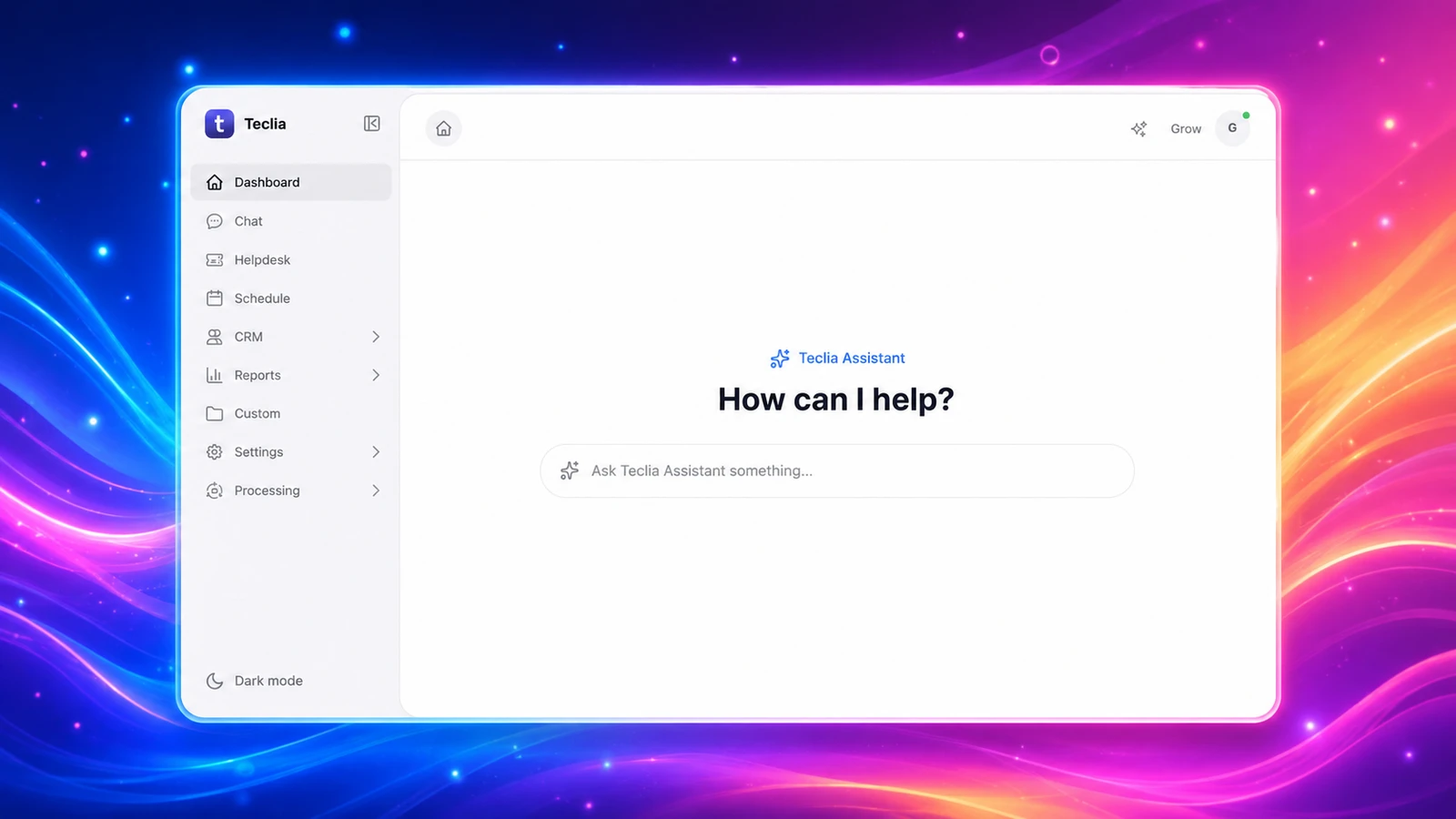
Serving a customer well has never been just about answering fast.
In support and customer relationship operations, a single interaction can involve history, context, priority, documents, images, internal rules, SLAs, and the need to decide when a request can be resolved automatically and when it should go to a person.
As volume grows, that challenge grows with it.
Teclia has worked in this market for 20 years and is today among the 10 largest customer service companies in Brazil. Across its operation, more than 2,000,000 tickets are processed every month for its clients, growing at an average of 5% a year.
That volume demands more than a service platform. It demands operational intelligence.
Teclia is using HiNow's infrastructure and models to expand its automation capacity, support human agents and offer intelligent agents capable of handling service autonomously, with the option to escalate to human teams whenever needed.
“Our vision is to combine productivity, context and quality in customer service. Artificial intelligence has to help the real operation, not just answer messages.”
— Marcia, Teclia
From a service center to an intelligent operation
Teclia's challenge is not only receiving tickets, but helping companies manage the entire service journey.
A single operation may involve:
- messages arriving in real time;
- opening and tracking tickets;
- service delivered by humans and by agents;
- reading attachments and images;
- replies by email;
- priority classification;
- routing between teams;
- monitoring through indicators and SLAs.
Teclia's proposal is to connect all of that in a single environment.
The platform brings together chat, helpdesk, automation and analytics, letting companies follow conversations, organize tickets, use autonomous agents and keep visibility over the operation.
HiNow's infrastructure helps Teclia run that experience with specialized models and flows. HiNova serves as the main foundation for coordinating and reasoning across the agents. HiGenesis supports the generation of replies, content and natural-language interaction. HiVision analyzes images sent by users and turns that material into descriptions the service team can act on.
Autonomous service with human escalation on hand
In many cases, the customer doesn't just want to talk to someone. They want the problem solved.
That problem may be simple — a question about status, a deadline or a procedure. But it may also demand interpretation, access to internal information, a look at documents, or a decision about whether the case needs to be routed elsewhere.
Teclia uses intelligent agents to work in that first layer of service.
These agents can:
- understand the customer's request;
- look up relevant information;
- answer frequent questions;
- interpret the context of the conversation;
- keep continuity across interactions;
- classify the type of request;
- open or update tickets;
- suggest next steps;
- route the case to a person when needed.
The important point is that automation does not replace the human operation. It expands what the operation can handle.
When the agent can resolve the case, service happens autonomously. When the case needs a human, the platform escalates it with the context preserved.
“Automation doesn't mean trapping the customer in a closed flow. It means resolving efficiently and handing over to a person at the right moment, with as much context as possible.”
— Marcia, Teclia
Humans and agents working at the same operational level
One of Teclia's distinguishing traits is how the platform treats intelligent agents and human agents inside the operation.
Instead of keeping the two worlds entirely apart, Teclia lets both work within the same service journey.
In practice, that means humans and agents can be treated as equivalent participants in the system, both able to communicate, contribute and help resolve requests.
The agent can start a conversation, gather information, answer questions and organize the context. The human agent can take the conversation over, review the history, add to the answer and carry out the next steps.
That continuity spares the customer from repeating information and reduces the friction at each handoff.
HiNow's infrastructure helps Teclia sustain this model, connecting the agents' flows to the platform's operational tools.
Chat as the entry point to smarter conversations
An important part of the experience begins in chat.
The customer sends a message, asks a question, reports a problem or requests help. From there, the system has to work out whether that demand can be resolved right away, whether it requires collecting more data, or whether it should move on to another stage of the operation.
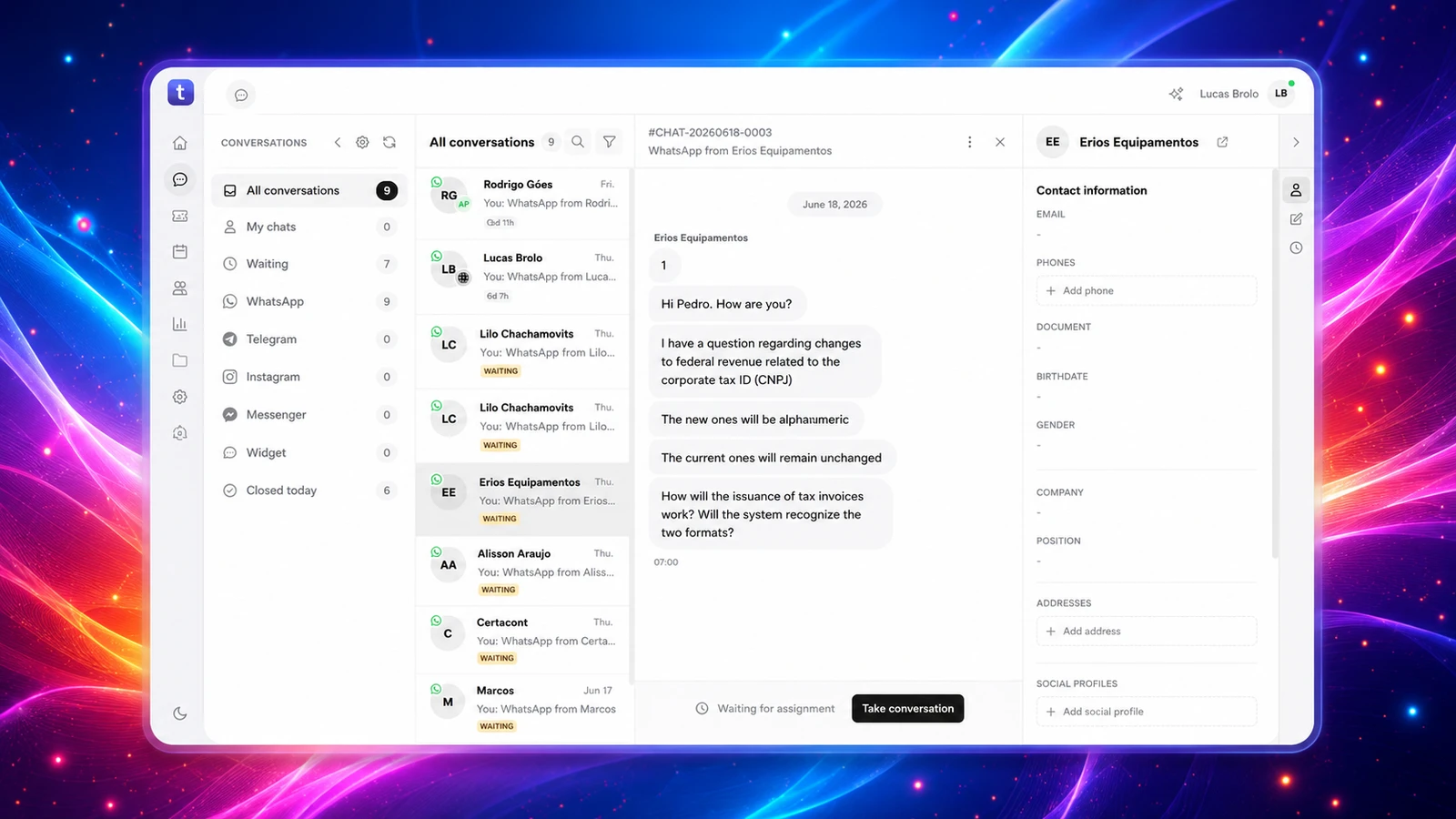
Teclia's chat environment lets intelligent agents and human agents work within the same service journey.
With support from HiNova, the platform interprets the user's intent and decides which flow to trigger.
HiGenesis helps build answers that are clear, natural and suited to the context of the interaction.
When the customer sends an image, HiVision can analyze the visual content and turn that material into a structured description. That helps in situations such as:
- submitted receipts;
- screenshots of errors;
- photographs of products or documents;
- evidence for support analysis;
- images that need to be described to enrich the ticket.
That lets the conversation move forward with more context and less manual work from the team.
“Modern customer service has to understand text, context and also the material the customer sends. Reading an image correctly can matter as much as interpreting a message.”
— Marcia, Teclia
A helpdesk with intelligence assisting the operation
When a demand grows into a more structured ticket, the helpdesk becomes the center of the operation.
In that environment, the team can track tickets, priorities, history, SLAs and work in progress.
But Teclia doesn't use artificial intelligence only at first contact. It also brings AI into the agents' own workflow.
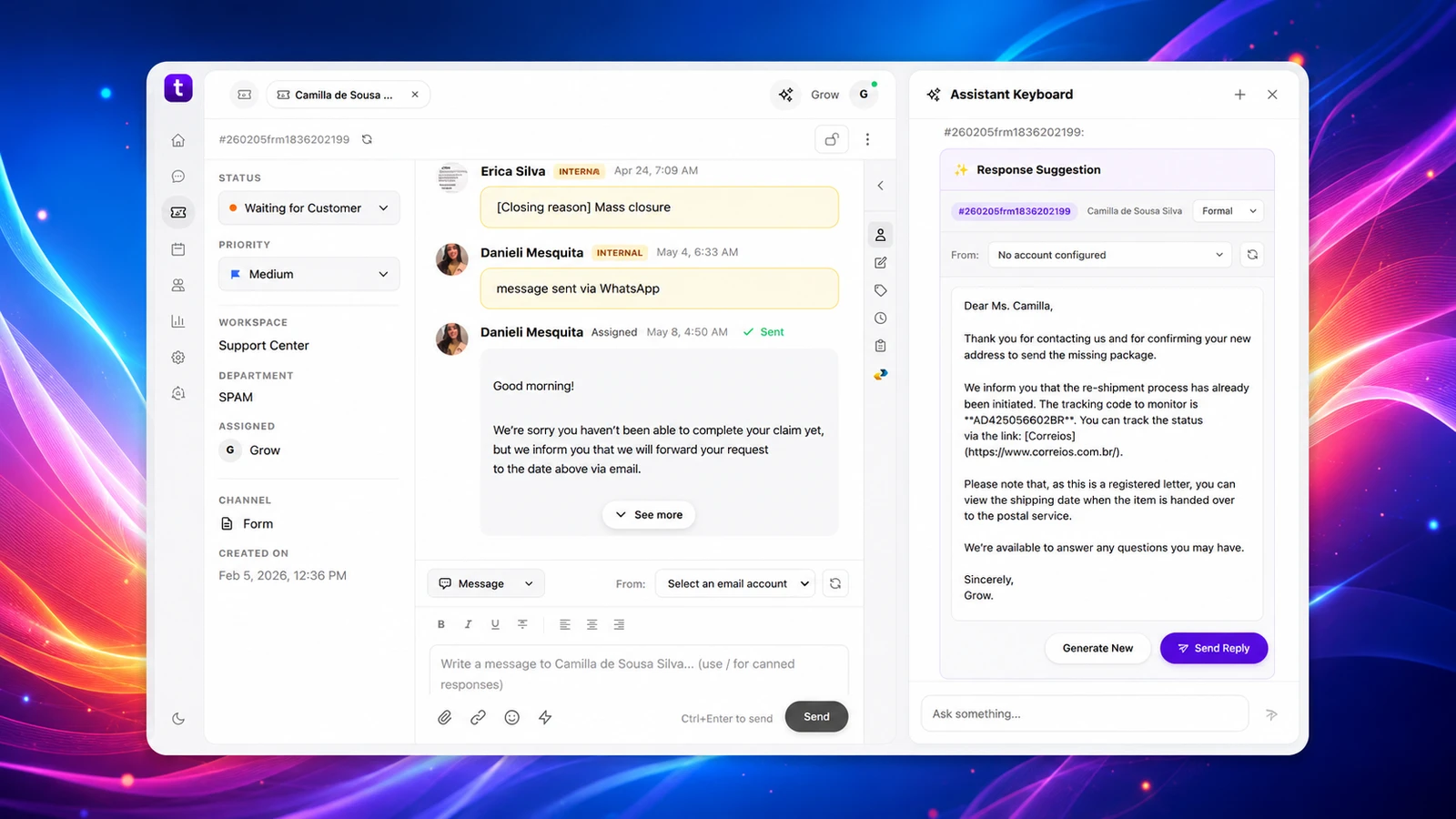
In Teclia's helpdesk, artificial intelligence supports the agent with context, suggestions and help composing the reply.
In this setting the human agent stays in control, but gets AI support to:
- summarize the ticket history;
- suggest replies;
- draft emails based on the context;
- keep communication consistent;
- look up prior knowledge;
- read the case faster;
- shorten response time;
- improve the consistency of service.
HiNova helps organize the ticket's context and understand the goal of the action. HiGenesis is used to suggest replies and support the drafting of content. HiVision can round out the flow when the case involves images sent by the customer.
This model turns AI into an operational assistant rather than an isolated feature.
An architecture connecting understanding, generation and visual analysis
To sustain this kind of experience, Teclia uses specialized HiNow capabilities.
HiNova acts as the coordination core for agents and flows. It interprets requests, defines the necessary steps, organizes the context and helps decide when a demand can be automated and when it needs escalation.
HiGenesis is used to generate natural-language content. It supports automatic replies, suggestions for human agents, email drafting and contextualized communication with the customer.
HiVision comes in when the interaction involves visual material. Its job is to analyze images, identify details and turn them into descriptions the operation can use.
Within a single ticket, the system may need to:
- interpret the customer's request;
- identify the intent;
- analyze a submitted image;
- summarize the context;
- build an initial reply;
- open or classify a ticket;
- suggest an answer to the human agent;
- escalate to a person, if needed;
- record everything in the right flow.
HiNow's infrastructure helps Teclia connect those steps into one continuous operation.
“It's not enough to have a model that writes well. You have to integrate understanding, context, operation and execution into the service routine.”
— Marcia, Teclia
Growing in scale without losing context
With more than 2,000,000 tickets a month across its clients, Teclia has to operate at scale without compromising service quality.
That calls for infrastructure able to handle high volume, multiple channels, different kinds of content and varying response times.
HiNow supports that operation with the infrastructure needed for:
- routing requests;
- running agents;
- analyzing images;
- generating replies;
- processing queues;
- storing context and history;
- integrating with the chat and helpdesk flows;
- distributing load across services.
That structure lets Teclia expand its automation capacity without losing control over the human operation.
It also lets the platform grow new capabilities as the technology advances.
Results that matter to the operation
Teclia measures the impact of artificial intelligence by how much it improves the real service operation.
In the context of this story, the most important indicators include:
- more than 2,000,000 tickets processed per month;
- average growth of 5% a year;
- greater capacity for autonomous service;
- shorter average response time;
- higher productivity among human agents;
- more consistent replies;
- better use of context between agent and human;
- greater capacity to analyze requests that include images;
- more efficiency in handling tickets and emails.
The next stage of customer service
Teclia's vision is to move toward an operation in which intelligent agents and human teams work in ever closer concert.
In that model, artificial intelligence will not be merely an entry point, but a continuous layer of support across the service journey.
Agents will be able to understand each customer better, act with more autonomy, read documents and images more accurately, and offer smoother transitions between automation and human service.
HiNow will keep supporting that evolution with HiNova, HiGenesis, HiVision and the infrastructure needed to run agents, process content, hold context and connect artificial intelligence to Teclia's tools.
For Teclia, the goal remains clear: use artificial intelligence to make customer service more efficient, more scalable and more useful both for companies and for their customers.