

Customer stories
From search to conversation: Wbuy reinvents e-commerce with AI
With Wbuy AI, intelligent agents, language models and image generation come together to understand the shopper, query the real catalog and turn intent into a purchase.

Finding the right product in an online store is not always simple. A shopper may not know the exact name of the item, may struggle to navigate dozens of categories, or may need help deciding between different options.
In a physical store, an experienced salesperson can make sense of sentences like “I need an outfit for a daytime wedding” or “I want something like this photo, but in another color”. In traditional e-commerce, that kind of request usually ends in a search with no results, a long conversation with support, or an abandoned cart.
Wbuy is working to change that experience.
With Wbuy AI, the company is bringing intelligent agents, language models and image generation directly into its merchants' operations. The goal is not merely to add a chatbot to the store, but to create an experience in which artificial intelligence understands the shopper, queries real catalog information, and helps turn an intention into a purchase.
“Shoppers shouldn't have to learn how an online store is organized in order to buy. The technology needs to understand what they want and help them reach the right product.”
— Fábio, CEO of Wbuy
From keyword search to a conversation about what the customer needs
A typical experience might begin like this:
- A shopper visits a store looking for an outfit for a specific occasion.
- They describe the event, state their preferences, or send an image as a reference.
- Wbuy AI interprets the request and identifies attributes such as style, color, category and price range.
- The system queries the products available in the store and presents compatible options.
- During the conversation, the shopper can ask new questions, change preferences and request alternatives.
- Once they find the right product, they are guided to the cart and to checkout.
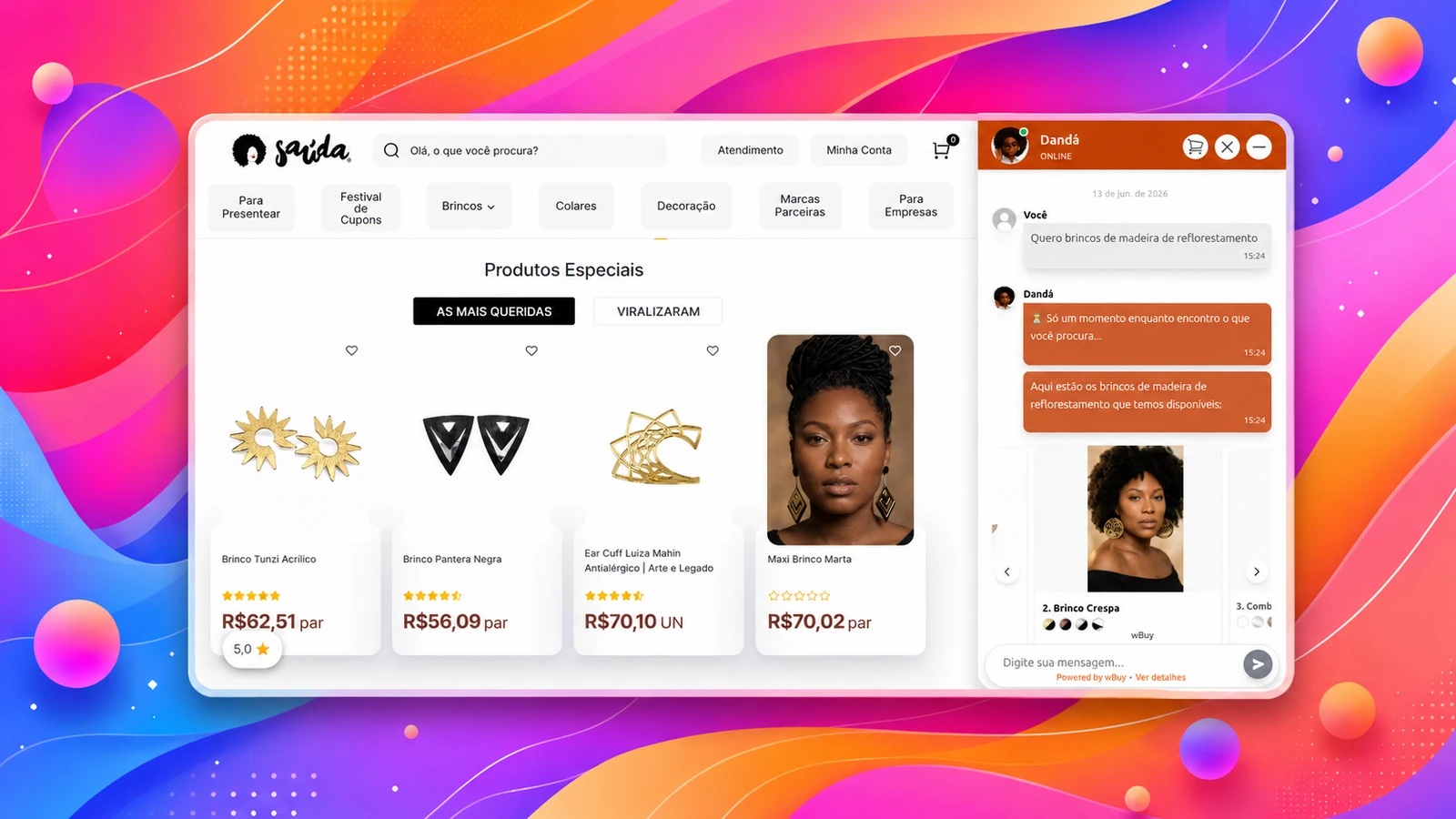
Wbuy AI leads the conversation, interprets the request and suggests real products from the catalog.
Every step depends on different information. The system has to understand natural language, analyze images, query the catalog, preserve the context of the conversation and call the right platform capabilities.
“The difference lies in connecting artificial intelligence to the operation. It can't just produce a convincing answer. It has to work with each merchant's real products, rules and information.”
— Paulo, CTO of Wbuy
Creating catalog content at scale
The shopper's experience is only part of the challenge.
Before a product can be found and recommended, the merchant has to list it properly. That means producing titles, descriptions, attributes, commercial information and images.
For operations with hundreds or thousands of products, that process can consume days of work. Incomplete information also undermines search engines, advertising campaigns and the ability of the artificial intelligence itself to recommend the right items.
Wbuy AI uses text models to turn basic information into structured, commercially sound descriptions suited to the context of each product.
Its visual capabilities make it possible to generate or enhance images, create new settings and develop material for storefronts and campaigns. That way the merchant can speed up product publishing without relying on an entirely manual process for every item.
A common workflow might involve:
- The merchant uploads a photograph and a few basic details.
- The artificial intelligence identifies the product's visual and commercial attributes.
- The system suggests a title, a description, attributes and content for promotion.
- Image generation models can create new visual presentations.
- The material is reviewed and published from within the store's own operation.
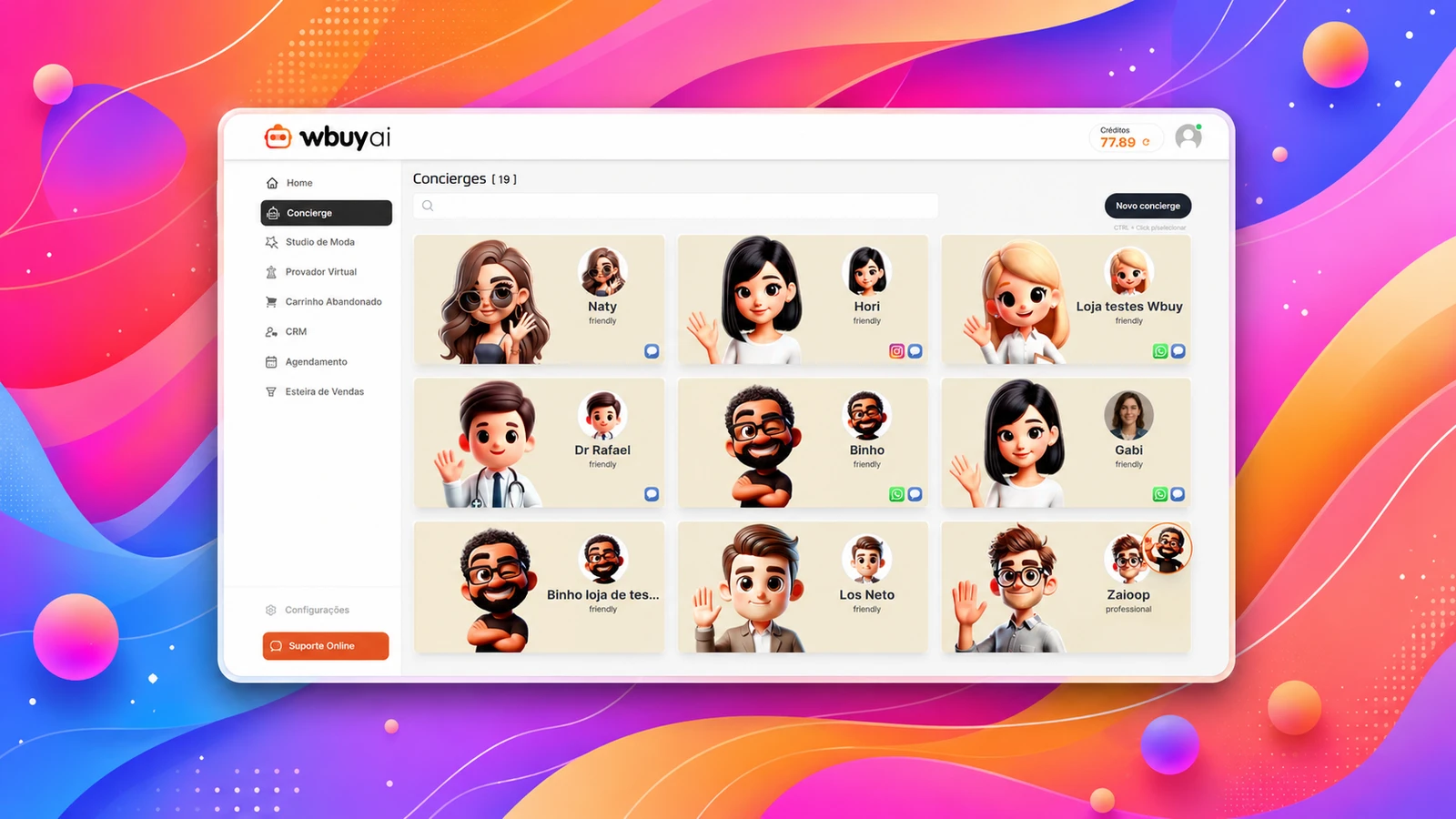
In the Wbuy dashboard, AI generates the title, description and images from basic product information.
“Our goal is to give a small business access to capabilities that used to require a large content, design and technology team.”
— Fábio, CEO of Wbuy
Building agents that don't just answer, but execute
To create this experience, Wbuy built an architecture based on distinct specialized capabilities.
Language models interpret requests, produce content and organize information. Multimodal models analyze images and relate visual references to products. Image generation systems support the creation of commercial material.
These capabilities are connected by flows that determine which tools should be used at each step.
Within a single conversation, the system may need to:
- identify the shopper's intent;
- extract preferences from the message;
- analyze an uploaded image;
- query products and variants;
- check commercial information;
- compare alternatives;
- answer questions;
- build a recommendation;
- guide the shopper to checkout.
HiNow's infrastructure helps Wbuy reach, combine and operate different artificial intelligence models inside those flows. Routing makes it possible to select the most suitable technology for each task, weighing accuracy, speed and operating cost.
For Wbuy, that structure reduces the dependence on a single model and allows new capabilities to be adopted as the technology evolves.
“We are not building Wbuy AI around a single model. We are building a platform capable of using the best technology available for each step of the experience.”
— Paulo, CTO of Wbuy
Bringing artificial intelligence to the reality of the Brazilian merchant
Most advanced artificial intelligence solutions still demand integrations, technical teams and investments that are out of reach for the majority of merchants.
Wbuy's strategy is a different one: to build those capabilities directly into the platform the merchant already uses every day.
That lets a company use artificial intelligence to produce content, improve images, serve shoppers and support sales without having to build its own infrastructure.
The technology also accounts for specific traits of the Brazilian market, such as the weight of WhatsApp in the buying journey, the need for service in natural language, and the range of sizes and levels of maturity among merchants.
“Artificial intelligence only creates value when it stops being a demo and starts solving real problems. For our customers, that means selling better, producing faster and serving people in a closer way.”
— Fábio, CEO of Wbuy
Results that have to show up in the operation
Wbuy measures the impact of artificial intelligence by what it manages to improve in the merchants' daily work.
The main indicators include the time it takes to list products, the volume of content produced, the number of shoppers served, the conversion of those interactions, and the ability to resolve requests without manual intervention.
The results already show in the merchants' day-to-day:
- a 70% reduction in product listing time;
- more than 15,000 images and pieces of content produced;
- 250,000 interactions handled by the agents;
- 35% growth in the conversion of assisted journeys;
- a 60% reduction in service time;
- 80% of requests completed with no human intervention.
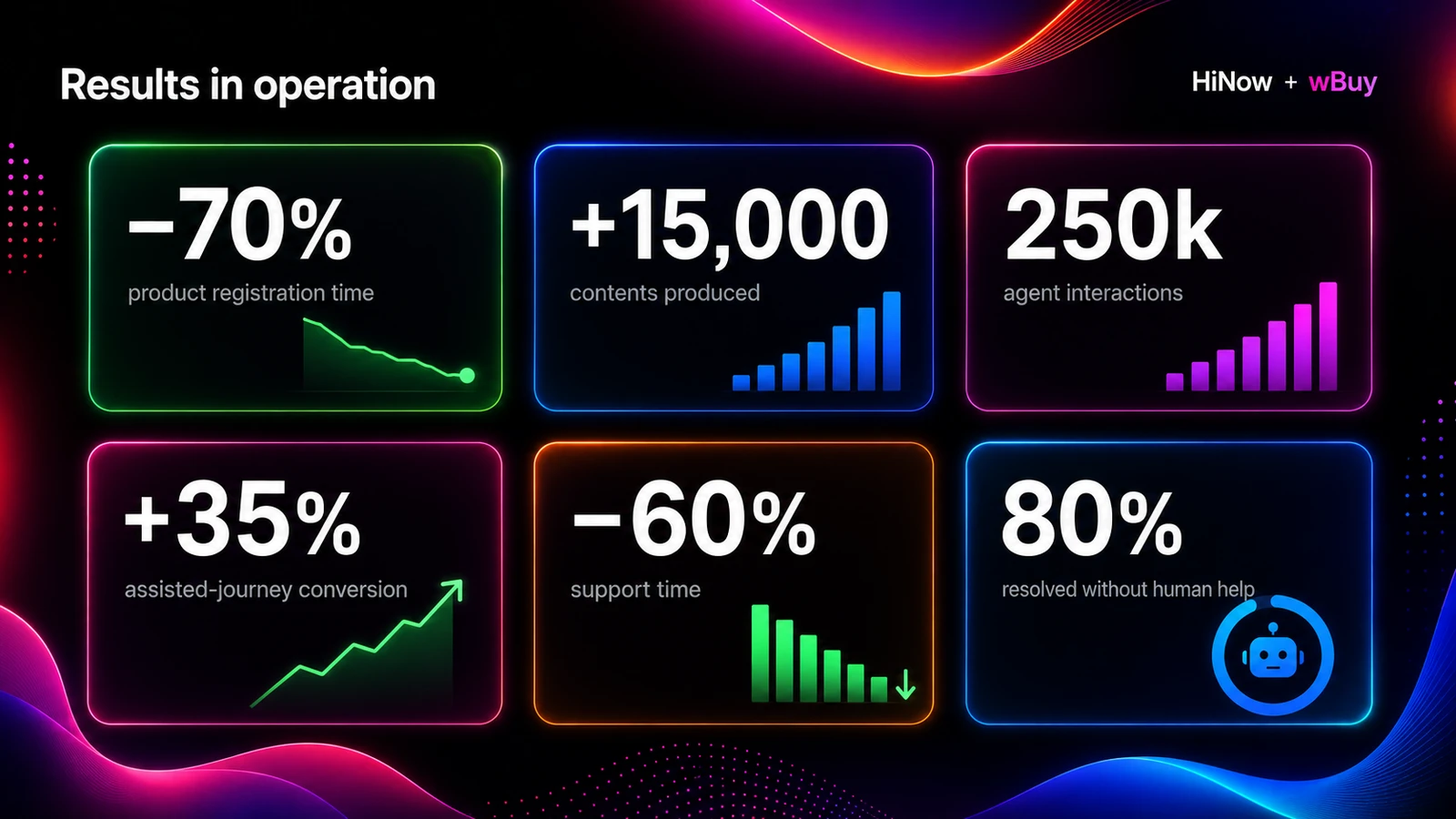
Wbuy AI results across the merchants' operations.
These figures show that artificial intelligence is not being used merely as a new interface feature. It is changing the merchants' productivity and the way shoppers find and buy products.
The next stage of e-commerce
Wbuy is moving toward an experience in which every store can have agents that know its catalog, understand its shoppers and follow the entire buying journey.
In the future, these systems will be able to hold context across separate interactions, understand recurring preferences and work in ever closer concert with customer service, marketing and commercial management.
The vision is to turn traditionally static online stores into experiences that are more intelligent, more conversational and more personal.
“We don't just want to put artificial intelligence inside e-commerce. We want to rethink how people discover products, talk to brands and make buying decisions.”
— Fábio, CEO of Wbuy
As the models evolve, Wbuy will be able to widen the range of tasks its agents carry out and offer those capabilities to a growing set of companies.
HiNow will keep supporting that evolution with the infrastructure needed to run text, image and reasoning models, and by building the flows that connect artificial intelligence to Wbuy's tools.
For Wbuy, the goal remains the same: to make advanced technology accessible to merchants and help define the next stage of Brazilian e-commerce.